Agenda

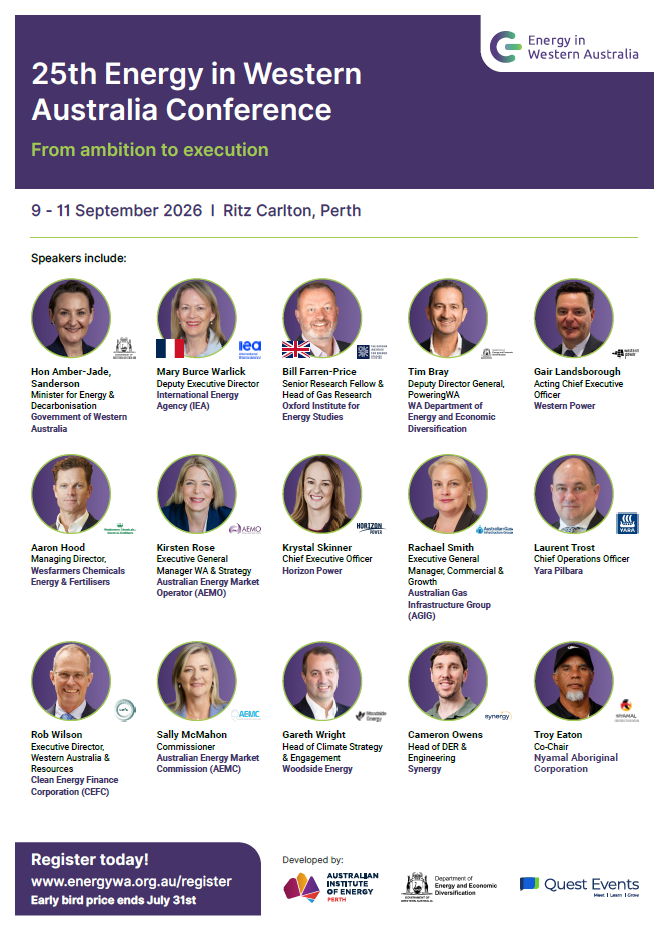
Sign up to receive updates/changes to the agenda and speaker line-up
Event Schedule
- 9 September - Pre-conference Masterclass
- 10 September - Conference Day One
- 11 September - Conference Day Two

- Day/Stream
- 9 September - Pre-conference Masterclass
- 10 September - Conference Day One
- 11 September - Conference Day Two

- Session Type
- Break
- Panel Discussion
- Masterclass
- Women in Energy Breakfast

- Time
- Morning
- Midday
- Afternoon
- Night
Registration and coffee
Welcome from AIE Perth conference committee Chair

Entellus Energy | Nu-phase
Welcome to country

Gundi Consulting
Opening remarks from the Chair

Australian Broadcasting Corporation (ABC)
Global perspectives and implications for energy sector in WA
Powering WA’s future: certainty, investment, and the path to net zero

Government of Western Australia
Reframing critical minerals competition to unlock Australia’s decarbonisation advantage
.png?width=53&height=53&name=Mary%20Burce%20Warlick%20(1).png)
International Energy Agency (IEA)
Reframing critical minerals competition to unlock Australia’s decarbonisation advantage
Retired senior U.S. diplomat and former Ambassador Mary Burce Warlick brings an unparalleled geopolitical lens to the global race for net-zero. Having shaped international energy security at the highest levels of the White House National Security Council, she brings insights into how to navigate fractured supply chains, win the global battle for green transition capital, and translate raw resource endowments into sovereign economic dominance.
- Competing for transition capital as energy, mining and critical minerals projects vie for investment
- Building downstream processing to capture more value from Australia’s critical minerals endowment
- Applying a geopolitical lens to decarbonisation to strengthen resilience, partnerships and long term advantage
International Energy Agency (IEA)
Securing WA’s industrial future: the role of gas in a changing energy system

Wesfarmers Chemicals Energy & Fertilisers
Securing WA’s industrial future: the role of gas in a changing energy system
- Strengthening local manufacturing capability in a constrained energy market
- Decarbonising industrial operations while remaining globally competitive
- Unlocking long-term advantage through the energy transition
Wesfarmers Chemicals Energy & Fertilisers
Morning tea
Powering Up WA - Delivering WA’s prosperous industrial future

Beyond Zero Emissions (BZE)
Powering Up WA - Delivering WA’s prosperous industrial future
WA has a history of stepping up and delivering globally-leading industries. From establishing itself as an energy powerhouse to creating the world's largest iron ore industry in one of the world's most remote locations, WA has shown the determination and ability to do great things. The foundation is being laid to transform WA's industrial regions, and Beyond Zero Emissions will be presenting on what industry, government and communities can do to:
-
Building on recent momentum to unlock a prosperous, resilient industrial future for generations to come
-
Coordinating and sequencing the infrastructure investment required to deliver the critical projects at the right time
-
Strengthening regional economies through industrial diversification and new value-added export opportunities underpinned by clean energy
Beyond Zero Emissions (BZE)
Optimising system design, market structure and investment signals
Transmission for the transition: What’s going on over east and what can we learn?

Australian Energy Market Commission (AEMC)
Transmission for the transition: What’s going on over east and what can we learn?
- How do the national rules support transmission investment?
- Why have jurisdictions developed their own schemes?
- What are the key challenges for delivery?
- What can be learned for the Pilbara?
Australian Energy Market Commission (AEMC)
Beyond capital and concept: breaching the WA grid “execution wall” to utility operator and FID gateways

Genus
Beyond capital and concept: breaching the WA grid “execution wall” to utility operator and FID gateways
Using real-world construction data from major 330kV and 132kV Western Australian grid connection projects, this presentation provides developers, asset owners, and planners with a clear framework to manage utility risk, satisfy commonwealth tender conditions, and transition assets from paper to physical delivery.
- Mapping the specific technical, governance, and plant-of-origin approvals required to clear Western Power operator gateways without delaying project schedules.
- Formulating a practical social license strategy that integrates buy-local initiatives and First Nations engagement to successfully meet PoweringWA and CIS tender requirements.
- Evaluating procurement and hedging structures to de-risk 2-to-4-year lead times on high-voltage critical infrastructure while strictly adhering to AIP plan constraints.
- Analysing workforce training models required to scale civil, electrical, and linework capacity locally to support long-term regional delivery.
Genus
Synergy welcome to lunch

Synergy
Panel discussion: Examining the realities of delivering transmission

Economic Regulation Authority Western Australia

Infrastructure WA
Genus

WA Department of Energy and Economic Diversification (DEED)

Western Power
Panel discussion: Examining the realities of delivering transmission
- What progress has the Clean Energy Link program made so far, and what does that reveal about the realities of delivering transmission in WA?
- How does the D&C contracting model work in practice across approvals, interfaces, outages and energisation windows?
- What delivery pressures have the greatest impact, from supply chain and workforce capability to regional logistics and live network integration?
- What lessons should be carried forward into future transmission builds and renewable energy zone developments?
Economic Regulation Authority Western Australia
Infrastructure WA
Genus
WA Department of Energy and Economic Diversification (DEED)
Western Power
Delivery gap: ambition vs execution, and what’s next for WA
Delivering scale efficient grid infrastructure to unlock value, and the role of the RTN in accelerating essential grid projects
.png?width=53&height=53&name=Rob%20Wilson%20(1).png)
Clean Energy Finance Corporation (CEFC)
Delivering scale efficient grid infrastructure to unlock value, and the role of the RTN in accelerating essential grid projects
- Reducing duplication by planning common-use corridors and staged network builds
- Accelerating renewable connection by bridging the timing gaps between transmission and generation/storage deployment
- Lowering whole-of-system cost by avoiding duplication and improving community outcomes
Clean Energy Finance Corporation (CEFC)
Panel discussion: What should WA adopt, adapt or avoid for the next phase of growth?

Curtin University

Auzvolt

Strike
Australian Energy Market Commission (AEMC)

Accenture
Panel discussion: What should WA adopt, adapt or avoid for the next phase of growth?
- What elements of WA's current framework are working well?
- What lessons from NSW and other jurisdictions should WA adopt or adapt?
- How can funding, regulation and delivery models continue to evolve?
- Where are the biggest opportunities to accelerate investment and project delivery?
- What should industry focus on over the next five years?
Curtin University
Auzvolt
Strike
Australian Energy Market Commission (AEMC)
Accenture
Afternoon tea
Who owns the energy transition in WA’s grid; utilities, technology, markets, or customers?
Utility perspective: Lessons from across Western Australia in enabling industry and delivering a stable and secure energy transition

APA Group
Utility perspective: Lessons from across Western Australia in enabling industry and delivering a stable and secure energy transition
- Decarbonising and connecting industry with common-use transmission infrastructure aligned with Western Australia’s Pilbara Energy Transition Plan
- Prioritising stakeholder, community and Traditional Owner engagement
- The role of deep energy storage in delivering reliability and enabling the closure of coal fire power generation
- Getting the settings right for domestic gas reservation to support local industry and the Australian economy as well as capture ongoing economic benefits from a strong LNG export market
APA Group
Customer perspective: Unlocking DER flexibility as a core energy system resource

Synergy
Customer perspective: Unlocking DER flexibility as a core energy system resource
- How DER aggregation can provide dispatchable capacity and system services, supported by real-world data and insights
- The engineering, interoperability, and operational capabilities required to scale DER participation reliably
- Integrating distributed batteries, solar, and EVs into the power system, including future pathways and learnings from recent technical work and ESOO-related analysis
Synergy
Market perspective: Strengthening market operability by sharpening storage signals and system incentives

WA Department of Energy and Economic Diversification (DEED)
Market perspective: Strengthening market operability by sharpening storage signals and system incentives
- Improving price and reliability signals so BESS long duration storage and firming capacity are rewarded more effectively
- Managing curtailment oversupply and volatility by aligning market settings with a more variable and decentralised system
- Coordinating storage flexible demand and renewable gas to support a more balanced and investable SWIS
WA Department of Energy and Economic Diversification (DEED)
Panel discussion: Unlocking the full capability of inverter-based resources in a rapidly changing SWIS

Aurecon
APA Group

Australian Energy Market Operator (AEMO)
Synergy

WA Department of Energy and Economic Diversification (DEED)

Tesla
Panel discussion: Unlocking the full capability of inverter-based resources in a rapidly changing SWIS
- How can WA unlock more value from inverter-based resources while maintaining system security as synchronous generation retires?
- What technical standards and performance requirements should WA prioritise to reflect its unique system characteristics?
- Which advanced inverter capabilities could make the biggest difference to system strength, stability and operability in the SWIS?
- How can WA accelerate renewable generation and storage integration without importing approaches that are not fit for local conditions?
Aurecon
APA Group
Australian Energy Market Operator (AEMO)
Synergy
WA Department of Energy and Economic Diversification (DEED)
Tesla
Closing remarks from Chair
Close of day one
Energy WA Awards Gala Dinner
Energy WA Awards Gala Dinner
Women in Energy breakfast
-1.png?width=53&height=53&name=Annabel%20Keogh%20(1)-1.png)
Synergy
Clean Energy Finance Corporation (CEFC)
Curtin University

Horizon Power
Women in Energy breakfast
07:00 Registration
07:30 Panel discussion: The Net Zero Countdown to 2030
Moderator:
Annabel Keogh, Head of Policy and Social Value, Synergy
Panellists:
Rob Wilson, Executive Director, Western Australia and Resources, Clean Energy Finance Corporation (CEFC)
Peta Ashworth, Director, Curtin Institute for Energy Transition (CIET), Curtin University
Alyce Stewart, Senior Manager Project Development, Horizon Power
Presented by Women in Energy – Perth and Young Energy Professionals (YEP) Perth


Tickets exclusively through Eventbrite
Synergy
Clean Energy Finance Corporation (CEFC)
Curtin University
Horizon Power
Welcome coffee
Opening remarks from the Chair
WA Department of Energy and Economic Diversification (DEED)
Leaning in to WA’s unique structural context: isolation, mining and regional activity
Navigating global gas volatility to strengthen WA’s LNG and domestic market position
.png?width=53&height=53&name=Bill%20Farren-Price%20(1).png)
Oxford Institute for Energy Studies
Navigating global gas volatility to strengthen WA’s LNG and domestic market position
Bill Farren-Price brings over 30 years of frontline energy macroeconomics and geopolitical expertise to the Energy in WA. A premier global authority on supply risk and market volatility, he delivers data-driven insights to help WA energy leaders navigate fractured international trade routes, stress-test export timing, and insulate local markets from sudden global shocks.
- Reading global gas balances to sharpen WA project timing and market strategy (ie What does the Oxford Institute of Energy Studies scenario planning tell us about risks and opportunities in global gas markets?)
- Managing geopolitical shocks to protect LNG revenues and domestic gas security
- Tracking Asia’s transition pathways to capture WA’s next gas and decarbonisation opportunities
Oxford Institute for Energy Studies
Making regional energy work
Regional WA’s energy transition: reliable, flexible and sustainable
.png?width=53&height=53&name=Krystal%20Skinner%20(3).png)
Horizon Power
Pragmatism not prescription - Manufacturing a successful energy transition
.png?width=53&height=53&name=Laurent%20Trost%20(1).png)
Yara
Working with regional communities on improving network resilience

Western Power
Project Meridien: electrons, molecules and photons — a third pathway for regional energy

Gingerah Energy
Panel discussion: Finding innovative, localised solutions to planning, markets and reliability in regional communities
Beyond Zero Emissions (BZE)
Horizon Power
Yara
Western Power
Gingerah Energy

Collgar Renewables
Panel discussion: Finding innovative, localised solutions to planning, markets and reliability in regional communities
- Tracking progress across the regions to share practical updates on projects already reshaping regional energy systems
- Examining how remote and regional networks are evolving through local generation storage microgrids and fit for purpose reliability solutions
- Understanding how load drivers regional areas are diversifying through mining decarbonisation new industrial demand and emerging data centre activity
Beyond Zero Emissions (BZE)
Horizon Power
Yara
Western Power
Gingerah Energy
Collgar Renewables
Morning tea
How AI can help clear the connection queue and de-risk transmission investment

ElectraNet
How AI can help clear the connection queue and de-risk transmission investment
- Accelerating renewable connections by applying AI to clear grid-planning bottlenecks
- Turning transmission data into faster, lower-risk investment and connection decisions
- Developing, trialling and scaling a solution where AI does heavy lifting without replacing human expertise
ElectraNet
What have we learned about grid modernisation/transformation?

Accenture (UK)
What have we learned about grid modernisation/transformation?
Accenture (UK)
What does a globally competitive WA look like?
Capturing more downstream energy value to turn WA’s strategic advantage into investment, jobs and green industry leadership

Magellan Power
Capturing more downstream energy value to turn WA’s strategic advantage into investment, jobs and green industry leadership
As the trailblazing founder of Magellan Power with over three decades of hands-on power electronics engineering expertise, Masoud Abshar is the definitive authority on onshore manufacturing. He offers a battle-tested blueprint for scaling advanced local supply chains, turning Australia’s critical mineral wealth into sovereign capability, skilled local jobs, and long-term economic resilience.
- Building more value onshore through batteries, storage systems and clean energy technology
- Turning the energy transition to strategic advantage into industry by converting WA capability into investment and jobs
- Strengthening green industry leadership by growing domestic supply chains, system capability and clean energy manufacturing capacity
Magellan Power
Lunch, sponsored by Western Power
Building an energy system that supports WA’s future competitiveness

Endgame Analytics
Building an energy system that supports WA’s future competitiveness
As an economist and former strategic modelling leader at EWEC, the UAE’s main ISO, Simon Arthur brings a rare international perspective on how power market design, system modelling and investment signals shape energy transition outcomes. Drawing on experience across Australia, the UK and the Middle East, he will explore what WA can learn from global parallels in geopolitics, data centres, green steel and industrial decarbonisation as it builds an energy system capable of supporting long-term competitiveness.
- Challenging planning assumptions that understate uncertainty, so WA can avoid costly blind spots and design for real-world volatility
- Building a more flexible, reliable, and investable power system that supports industrial growth, electrification, and long-term price competitiveness
- Aligning generation, transmission, storage, and firming decisions with the needs of a globally competitive WA economy, not just average-case scenarios
- Redesigning regulatory and market frameworks to reward resilience, unlock capital, and keep Western Australia attractive for major energy users and investors
Endgame Analytics
Achieving social licence & community outcomes & communicating the message
Q&A: Shifting from consultation to co-ownership to expand First Nations participation in energy projects

Nyamal Aboriginal Corporation

Indigenous Energy Australia
Q&A: Shifting from consultation to co-ownership to expand First Nations participation in energy projects
- Examining Fortescue’s Pilbara project through Nyamal concerns about consent and Traditional Owner-led decision-making
- Working with the First Nations Clean Energy Network to strengthen governance, negotiation capability and project literacy
- Building long-term economic independence through First Nations ownership, procurement, decision-making and renewable power rollouts
Nyamal Aboriginal Corporation
Indigenous Energy Australia
Strengthening social licence by building energy literacy and countering misinformation in our communities

Populares
Strengthening social licence by building energy literacy and countering misinformation in our communities
As a global political strategist and author of Angertainment and Facts and Other Lies, Ed Coper brings unparalleled, frontline expertise on how to protect the transition from weaponised digital campaigns. He bridges the gap between infrastructure development and public trust, offering energy industry a vital, battle-tested blueprint to disarm misinformation and secure genuine local support.
- Building trust by engaging communities early, clearly, and repeatedly so energy projects earn permission as well as approval
- Strengthening energy literacy by translating complex system changes into plain language that helps communities understand costs, reliability, and benefits
- Countering misinformation by using trusted local voices and evidence-led storytelling to reduce fear and protect support for the transition
Populares
Planning firming, flexibility and gas for a secure transition
Gas enablement: moving supply and pipeline capacity from outlook to execution
.png?width=53&height=53&name=Rachael%20Smith%20(1).png)
Australian Gas Infrastructure Group (AGIG)
Gas enablement: moving supply and pipeline capacity from outlook to execution
- Assessing the Perth Basin outlook and what speed to market really requires across approvals, investment decisions, offtake, processing and connection
- Testing whether enabling infrastructure is on track, and where gaps in processing, compression, storage and pipeline access could slow new supply
- Mapping pipeline augmentation timelines against emerging demand, peak reliability needs and domestic gas security risks
- Examining the practical realities of increasing pipeline capacity, including commercial triggers, outage planning, construction lead times and customer underwriting
Australian Gas Infrastructure Group (AGIG)
Afternoon tea
Planning the transition points: keeping the SWIS secure as renewables scale
.png?width=53&height=53&name=Kirsten%20Rose%20(1).png)
Australian Energy Market Operator (AEMO)
Planning the transition points: keeping the SWIS secure as renewables scale
- Using scenario-based planning to identify when and where the SWIS will need new system support
- Maintaining system strength and essential system services as synchronous generation retires
- Deploying flexible, dispatchable capacity to support reliability while enabling higher renewable penetration
Australian Energy Market Operator (AEMO)
Panel discussion: What should be the strategic role and limits of gas in Western Australia’s transition?

Woodside Energy

AGL | Perth Energy
Oxford Institute for Energy Studies
Australian Gas Infrastructure Group (AGIG)

Wärtsilä Energy
Panel discussion: What should be the strategic role and limits of gas in Western Australia’s transition?
- How much gas does the system actually need as coal exits and renewable penetration rises without defaulting to oversized long lived infrastructure?
- How should gas be used as a transitional reliability backstop while storage electrification and other firming options take on a greater role?
- How should pipeline and generation investment be sized against realistic long term demand to avoid stranded assets and misplaced capital?
- Who should bear utilisation and stranded asset risk before new gas infrastructure is underwritten by customers or taxpayers?
Woodside Energy
AGL | Perth Energy
Oxford Institute for Energy Studies
Australian Gas Infrastructure Group (AGIG)
Wärtsilä Energy
Closing remarks from AIE Perth conference committee Chair
Entellus Energy | Nu-phase
Close EWA 2026, Networking drinks
Introductory Masterclass: Western Australia energy industry boot camp

Curtin University

Edith Cowan University

Western Power

Australian Energy Market Operator (AEMO)

WA Department of Energy and Economic Diversification (DEED)
Gundi Consulting

Clean Energy Skills National Centre of Excellence
Introductory Masterclass: Western Australia energy industry boot camp
Specifically for professionals new to Western Australia’s energy sector, this workshop provides an accessible overview of the key organisations shaping the state’s unique energy landscape. Designed for engineers, consultants and policy professionals at the early to mid-career stage, it will help bridge gaps in awareness of how WA’s energy systems operate outside the National Electricity Market.
Upon completion of the workshop, attendees will
- Understand the context of the South West Interconnected System (SWIS) and the Wholesale Electricity Market (WEM) in WA
- Identify the major players, agencies and their interactions across interconnected and remote networks
- Develop insight into current issues and challenges for the WA energy sector
- Gain perspective on future directions and opportunities in WA’s evolving energy transition
Outline:
08:30 Registration and coffee
09:00 Welcome and setting the scene: skills for the energy transition
- Introduction to the Clean Energy Skills National Centre of Excellence, the purpose of the workshop, and an overview of the energy transition, workforce challenges and opportunities facing Western Australia
Ty Theodore, General Manager, Clean Energy Skills National Centre of Excellence
9:30 Understanding the key players in WA’s energy sector
- Explore the role of the WA government in coordination with WA’s key energy agencies
- Develop insight into current issues and challenges for the WA energy sector
Stephen Eliot, Executive Director Energy Policy WA, Commercial, WA Department of Energy and Economic Diversification (DEED)
10:00 Understanding the WEM and context of the SWIS
- Gain an understanding of Western Australia's unique electricity market, including the history of the WEM, the SWIS, key market mechanisms and how WA differs from the National Electricity Market
Jean-Phillipe Montandan, Principal – WA Operations, Australian Energy Market Operator (AEMO)
10:30 Morning tea
11:00 Enabling a once-in-a-generation energy transition
- Western Power's role in WA's energy system and our relationship with key sector participants
- How the SWIS is evolving through the energy transition
- Growth of distributed energy resources across the network
- VPPs, community batteries and the future of customer energy resources
Megan Allan, Head of Distribution Energy Transition, Western Power
11:30 Energy transition on Country: opportunities, challenges and ‘two way learning’ in Western Australia
- Framing the energy transition through Traditional ownership, stewardship and two-way learning on Country
- Examining how renewable energy, land access and infrastructure development affect regional communities and social licence
- Exploring industrial decarbonisation, green iron opportunities and the practical implications for energy, water and transmission
- Identifying how regional communities can participate in renewable energy development while minimising long-term land and infrastructure burdens
Oral McGuire, Principal Consultant, Gundi Consulting
12:00 Energy industry insights Q&A panel
- Facilitated discussion with key energy industry players. Participants can ask questions about the electricity system, industry trends, workforce needs and career opportunities in the sector
Megan Allan, Head of Distribution Energy Transition, Western Power
Jean-Phillipe Montandan, Principal – WA Operations, Australian Energy Market Operator (AEMO)
Stephen Eliot, Executive Director Energy Policy WA, Commercial, WA Department of Energy and Economic Diversification (DEED)
Oral McGuire, Principal Consultant, Gundi Consulting
Ty Theodore, General Manager, Clean Energy Skills National Centre of Excellence
12:30 Lunch
13:30 Battery fundamentals - where BESS fits in the energy system
- How BESS supports reliability, flexibility and peak demand management by storing surplus renewable generation
- Understanding core BESS components, including battery chemistry, inverters, control systems, sizing, duration and performance parameters
- Identifying the practical decisions that shape BESS project success, including location, use case, safety and system value
- Exploring the battery value chain, technology options, and key opportunities and challenges for BESS in Western Australia
Muhammad Rizwan Azhar, Lecturer, School of Engineering, Edith Cowan University
14:30 Afternoon tea
15:00 (approximate) Close of day
Curtin University
Edith Cowan University
Western Power
Australian Energy Market Operator (AEMO)
WA Department of Energy and Economic Diversification (DEED)
Gundi Consulting
Clean Energy Skills National Centre of Excellence
- Day/Stream
- 9 September - Pre-conference Masterclass
- 10 September - Conference Day One
- 11 September - Conference Day Two
- 9 September - Pre-conference Masterclass
- 10 September - Conference Day One
- 11 September - Conference Day Two
Download the brochure for more information on the full agenda and speaker line-up